Chime Card Scams: How They Happen, and the First Hour
A Chime card scam is not one problem but three, and they resolve through three different routes: the card itself, the account behind it, and — because Chime is a fintech rather than a bank — the partner bank that actually holds your deposits. Getting the order wrong is what turns a recoverable fraudulent charge into a loss, and it is why so many Chime card complaints stall in a support queue for weeks. This page is the order.

Chime Card Scams. Freeze First, Argue Later
Chime Card Scams: The Short Version
- Freeze the card first — in the app, Profile → Cards. This is the only step that stops the next charge.
- Chime is not a bank. Deposits sit with partner banks, and that decides who you escalate to when Chime's own support stalls.
- Authorized-push scams are not fraud claims. A payment you were tricked into sending is legally authorized, and a dispute will be declined.
- Card fraud is different: an unauthorized charge on your card carries regulatory protections that a scam payment does not.
- Never pay anyone who contacts you offering to "reverse" a Chime charge. Chime does not call or text you unsolicited.
Why Chime is not a bank, and why that decides your route
This is the fact most Chime card-scam guides skip, and it is the one that determines who you can actually escalate to.
Chime is a financial technology company, not a bank. Your deposits are held at partner banks, and the debit card is issued through them. That structure is legal and common, and it has a specific consequence in a dispute: the entity that must answer a formal error claim is the institution holding the account, not the app you talk to.
| What happened | Who you contact first | Who you escalate to |
|---|---|---|
| Unauthorized card charge | Chime app — freeze card, then in-app dispute | The issuing partner bank, then regulators |
| You were tricked into sending money | Chime support | Often no route — authorized payment |
| SpotMe / overdraft dispute | Chime support | Partner bank complaint |
| Account closed with funds inside | Chime support in writing | Partner bank, then CFPB |
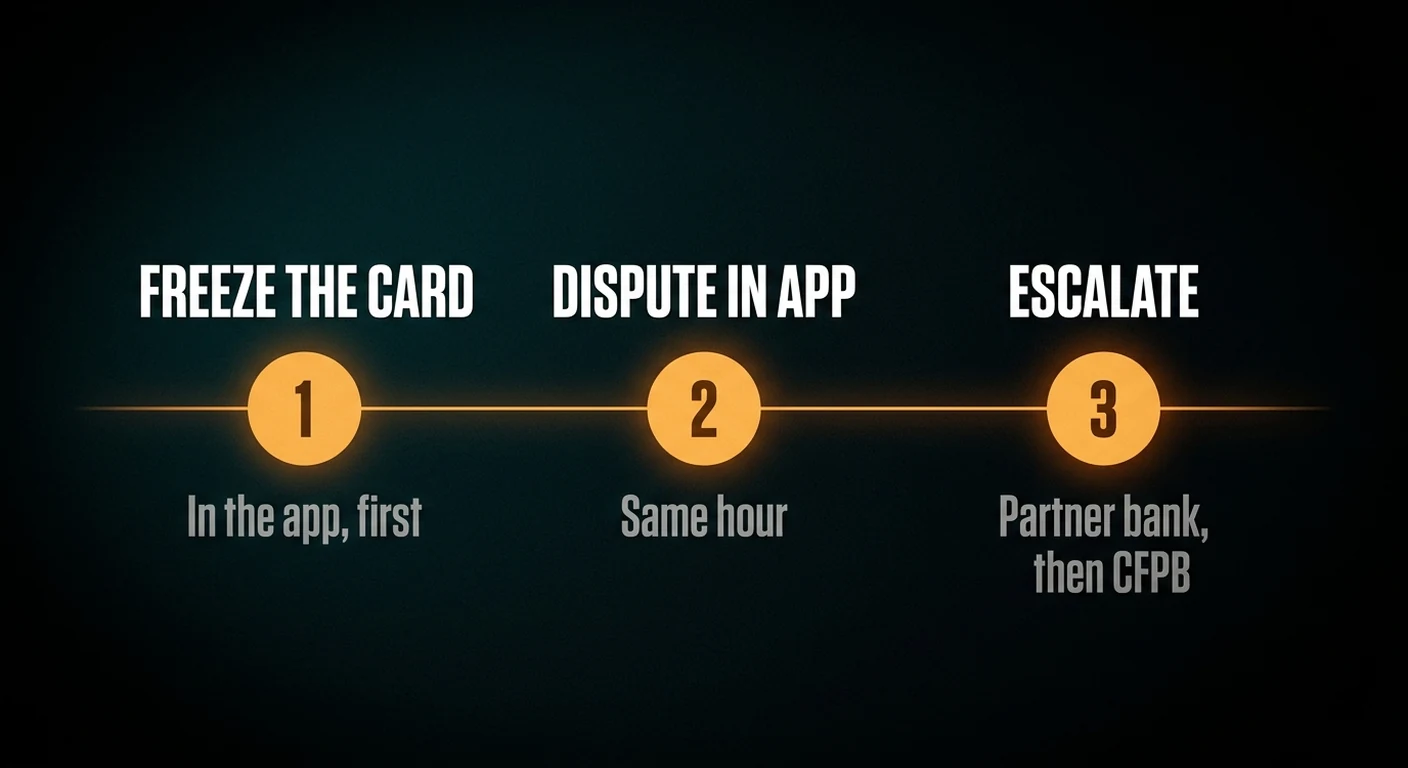
In practice this means the escalation path has two rungs, and most people never use the second. When Chime's support says no, the next step is not a louder message to Chime — it is a written complaint to the partner bank, and then a regulator. That sequence is what the later sections cover.
The card-scam patterns that actually hit Chime accounts
These are card-mechanics scams rather than investment or romance scams. They share one characteristic: the attacker needs the card number, not your trust over weeks.
| Pattern | How it works | What you see first |
|---|---|---|
| Phishing SMS or email | A message impersonating Chime asks you to "verify" a transaction or confirm a delivery, and links to a lookalike page that captures the card number and code. | A text about a charge you do not recognise |
| Card-not-present fraud | The number is used online after a merchant breach or a data sale. No physical card is involved. | Small test charges, then a large one |
| Skimming at a terminal | An overlay on a fuel pump or ATM reads the magnetic stripe; the PIN is captured by camera or keypad overlay. | Cash withdrawals you did not make |
| "Chime fraud department" call | A caller says your account is compromised and walks you through "moving" funds to a safe account, or asks for the one-time code. | A call you did not initiate about fraud |
| Overpayment / refund mule | Someone "overpays" you and asks for the difference back; the original payment later reverses. | An unexpected credit plus a request |
Two of these are unauthorized (phishing capture, card-not-present, skimming) and two are authorized-push (the fake fraud call, the overpayment refund). That distinction, not the dollar amount, is what decides whether a dispute can succeed.
The first hour, in order
The sequence matters because each step closes a door the previous one leaves open.
| # | Action | Where | Why now |
|---|---|---|---|
| 1 | Freeze the card | App → Profile → Cards → Freeze card toggle | Stops further charges immediately. Reversible in seconds. |
| 2 | Change the password and enable 2FA | App → Settings → Security | If the attacker had a code, the session may still be live |
| 3 | Screenshot every transaction | App → transaction list | The dispute window is short and the record is evidence |
| 4 | File the in-app dispute on each charge | Tap the transaction → Dispute | Pending charges cannot be disputed — wait for them to post |
| 5 | Request a replacement card | App → Profile → Cards | The old number is compromised; unfreezing it would restart the loss |
| 6 | Get the dispute reference in writing | Support chat → email yourself the transcript | You will need it for the escalation rung |
Why step 4 has a timing trap
Chime's own help documentation is explicit that pending transactions cannot be disputed — the dispute option only appears once a charge has posted. A scammer's first charge is often small and authorised-looking precisely to test the card; the large charge follows. Do not wait to freeze in order to “collect evidence”. Freeze now, dispute as each charge posts.
What a Chime claim actually needs to succeed
A card dispute is decided on a small set of facts, and most denials come from missing one of them rather than from the bank disbelieving the customer.
- Which charges are disputed, individually. A claim saying "my card was used fraudulently" without a list is returned. Name each transaction, date and amount.
- That the card was in your possession. If it was lost or stolen, say so — the protection still applies but the timeline changes.
- That you did not authorise the transaction. This is the core assertion, and it is the one that fails when the payment was a scam you were talked into.
- What you did when you noticed. Freeze time, report time, and the fact that they are close together is itself evidence.
- Any police or FTC report number if the amount is large or identity data was exposed.
The distinction that decides the claim
If you were tricked into sending a payment — a fake fraud caller, a fake buyer, a fake job — the transaction is legally authorised. Regulators treat it as a scam rather than an error, and a card dispute is generally declined for that reason. This is not the bank being unhelpful; it is the boundary of what the dispute process covers. The honest route in that case is a fraud report and, where a moneyless channel was used, a bank-level complaint — not a second dispute attempt with different wording.
If the charge was made without your participation, it is an error claim, and the protections are real. Keep the two apart when you write the claim; mixing them is the fastest way to have it read as an authorized-push case and declined.
Escalating past Chime support
When the in-app route stalls, the escalation is documentary rather than emotional. Three rungs, in order.
| Rung | What you send | What it achieves |
|---|---|---|
| 1. Written complaint to Chime | Dispute reference, transaction list, dates, what you were told, screenshots | Creates a dated record — required before most later steps |
| 2. Partner bank complaint | The same file, addressed to the institution holding the deposits | The entity that must answer a formal error claim |
| 3. CFPB complaint | The file plus both prior references | Routes to a supervised response with a deadline |
Each rung is faster when it can cite the previous one by reference number. A complaint that begins at rung three without rungs one and two is answered, but often with a request to go back and complete them first — which is time you spend twice.
For the dispute mechanics themselves — which transaction types are covered, the escalation wording, and the evidence a claim needs — the dedicated Chime dispute page goes deeper than this one does. If the charge landed on a debit card rather than a Chime account, the debit card dispute rules are the ones that apply.
The recovery offers that follow a Chime card scam
A public post about a Chime loss attracts a specific kind of reply within days, and it usually arrives as empathy first.
| What they offer | Why it cannot work |
|---|---|
| "I can get Chime to reverse the charge" | Only the bank can act on a dispute, and it acts on evidence, not on a third party's request |
| "Pay a retainer and we file for you" | Filing a CFPB complaint is free and takes fifteen minutes |
| "Send the disputed amount and we return it doubled" | The classic advance-fee shape |
| A DM from someone "who had the same thing" | Two accounts, one operator, and the second account is the "expert" |
The structural point: nothing a third party can do to a Chime dispute is unavailable to you. The complaint is free, the reference numbers are yours, and the escalation rungs are published. That is also why no legitimate firm sells this service — there is nothing to sell that you cannot do.
Questions people ask about Chime card scams
What should I do first if my Chime card was used fraudulently?
Freeze the card in the Chime app under Profile, then Cards — this stops new authorisations immediately and is reversible with one tap. Then change your password, enable two-factor authentication, screenshot the transactions, and file an in-app dispute on each posted charge. Pending charges cannot be disputed, so freeze first and dispute as they post. Finally, request a replacement card so the compromised number cannot be reused.
Is Chime a bank, and does that matter for a dispute?
Chime is a financial technology company rather than a bank; deposits are held at partner banks and the card is issued through them. It matters because the entity that must answer a formal error claim is the institution holding the account. When Chime support declines, escalation goes to the partner bank and then to the CFPB, citing the earlier reference numbers.
Will Chime refund me if I was scammed into sending money?
Usually not through the card dispute process. A payment you were persuaded to send is legally authorised, so regulators treat it as a scam rather than an error, and a dispute is generally declined for that reason. Card fraud protections apply to charges made without your participation. If you were tricked into sending funds, the realistic routes are a fraud report and a written complaint, not a second dispute with different wording.
Can I dispute a pending Chime transaction?
No. Chime's help documentation states that pending transactions cannot be disputed and that you must wait until a transaction posts before submitting a dispute. This is precisely why freezing the card should come before anything else — it stops further charges while you wait for the fraudulent ones to post so they can be claimed.
Someone called claiming to be from Chime fraud support. Is it real?
Assume it is not. Chime states that it will never call or text you without your authorisation and will only ask for a verification code when you contacted Chime first. A caller who says your account is compromised and asks you to move money to a safe account, or asks for a one-time code, is running the standard impersonation scam.
How long do I have to report a fraudulent Chime charge?
Report as soon as you notice, and do not wait for a convenient moment. The protections tied to card fraud depend partly on prompt reporting, and a delay that looks like tolerance of the charge weakens the claim. Freezing the card immediately also creates a timestamp that supports the report. Keep every reference number in writing.
Freeze first, then build the paper trail
The card freeze takes ten seconds and stops the loss. The evidence file is what decides the claim — and it is easiest to build in the first hour.
Primary sources and further reading
- Chime Help — How do I dispute a charge on my card? — help.chime.com
- Chime Help — How do I know if I'm being phished? — help.chime.com
- Chime Help — Identity theft or unauthorized activity — help.chime.com
- CFPB — Submit a complaint — consumerfinance.gov
- FTC — ReportFraud.ftc.gov — reportfraud.ftc.gov
Related guides
Information only. We never promise recovery.