How to File a Police Report for Crypto Fraud (With a Statement Template)
A police report for crypto fraud is usually a prerequisite, not an investigation. Here is how to write a statement officers can file, what to bring, which jurisdiction to use, and how to get the report number your bank needs.
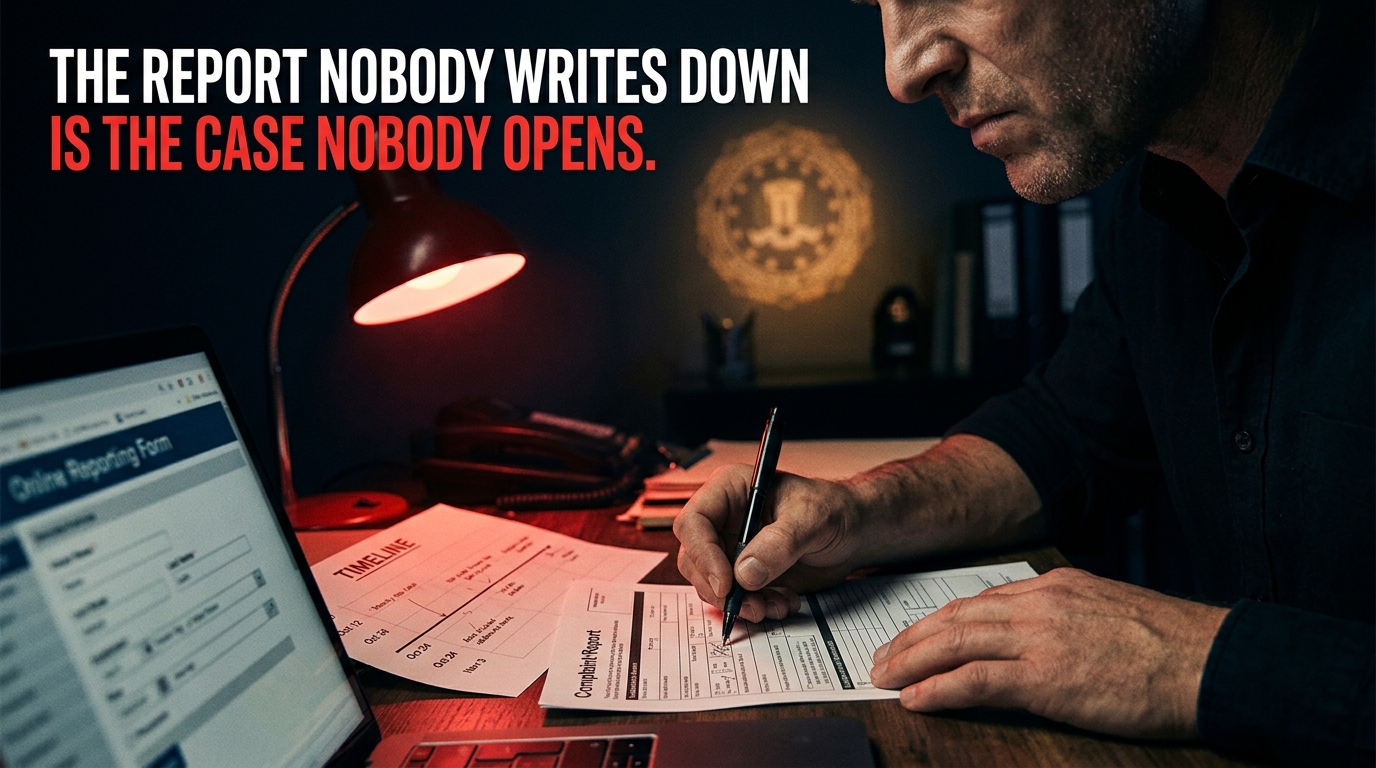
The Report Number Is the Deliverable. The Investigation Is Not.
Why a one-page written statement gets filed and a verbal account does not.
What this guide says in 5 lines
- A police report for crypto fraud is usually a prerequisite for other remedies, not an investigation in itself.
- Bring a one-page written statement. Officers file documents; they do not transcribe hour-long accounts.
- Jurisdiction is where you live or where the loss occurred — not where the scammer claims to be.
- The report number is what your bank, insurer and exchange will ask for. Get it in writing.
- If the desk refuses to take it, ask for the refusal in writing and escalate to a supervisor or the state AG.
Most victims expect a police report to start an investigation. In practice it usually does something more modest and more useful: it creates an official, dated record that a bank, an insurer, an exchange compliance desk or a lawyer will accept as proof that a crime was reported. That record is frequently a prerequisite for remedies that do work, which is why the report is worth getting even when you are certain no detective will ever call you.
The practical problem is that crypto fraud does not fit the form at the front desk. Officers are trained for burglary and assault, not UTXO clustering, and a victim who arrives without a written statement often leaves with nothing filed. This guide gives you the statement, the evidence bundle and the escalation path.
What a police report actually gets you
Be clear about the purpose before you spend an afternoon at a station. The report is a document, and its value is that other institutions require it.
- A bank or card issuer may require a police report number before processing a fraud claim or a chargeback.
- An insurer may require it for a claim under a cyber or fraud policy.
- An exchange compliance desk will weigh it heavily when deciding whether to freeze funds.
- A lawyer will need it to open a civil claim or to engage a forensics firm.
- It creates a dated record that you reported promptly, which matters in every later process.
Ask for the report number in writing before you leave, and ask which officer or unit it is assigned to. A report you cannot cite is a report that does not help you.
Which jurisdiction to file in
This is the question that stops most victims. The scammer is overseas, the platform is offshore, the blockchain has no location — so where do you file?
The answer is simpler than it looks. File where you live, or where the loss occurred from your side. Your local police have jurisdiction over a crime committed against you in their area, and that is the report your bank will accept. You do not need to identify the offender's location, and you should not try.
| Agency | When to use it | What it produces |
|---|---|---|
| Local police | Always, as the primary report | A report number your bank and insurer accept |
| State or provincial police | If local police decline or the loss is large | A higher-level report and, sometimes, a cyber unit referral |
| National cybercrime unit | For large losses or cross-border elements | A federal reference that carries weight with exchanges |
| IC3.gov | Always, in parallel | A federal intake record and clustering |
| Financial regulator | If a bank or platform mishandled the case | A complaint process with a defined response duty |
Do not tell the officer the scammer is in another country as a reason not to file. That is the scammer's advantage, not a jurisdictional bar. Your report is about the crime committed against you where you are.
The one-page statement template
Write this before you go. Print two copies: one to hand over, one to keep with the officer's signature or stamp on it. Keep it factual, dated and free of conclusions.
- 01Your full name, address, date of birth and contact details.
- 02A single opening sentence: “I wish to report a fraud in which I lost [amount] in cryptocurrency between [start date] and [end date].”
- 03A numbered chronology of events, each with a date, an amount and the route the money took.
- 04The identifiers: every crypto address, transaction hash, domain, phone number and email involved.
- 05A description of how you were contacted and what the platform claimed to be.
- 06A list of the evidence you are providing, named item by item.
- 07A closing line: “I am requesting a police report number for the purposes of a bank dispute and a federal complaint.”
- 08Your signature and the date.
Bring the evidence on a USB stick and as printed copies. Many stations cannot accept a USB, and a printed trace is what actually gets attached to the file.
What to bring
Arrive with a complete bundle. An officer who has to ask you to come back with documents will often close the file instead.
- The printed one-page statement, signed and dated.
- A written trace: numbered hops with dates, amounts and addresses.
- Transaction confirmations or explorer printouts, one per transfer.
- Bank, card or exchange records showing the funds leaving your control.
- The platform's pages: deposit page, withdrawal page, terms, any dashboard.
- The recruitment conversation, exported or printed.
- Your ID, and the IC3 confirmation number if you have already filed.
Never hand over your seed phrase, private key or exchange password to anyone, including an officer. No legitimate investigation requires them, and a request for them is itself a red flag.
If the desk refuses to take it
This happens, and it is usually a training gap rather than a policy. Crypto fraud does not fit the standard categories, and a front-desk officer may genuinely not know where to file it. Do not argue about the technology; ask for the process.
- 01Ask to speak to a supervisor or the officer in charge of the shift.
- 02Ask specifically for a report number, and explain that a bank dispute and a federal complaint both require one.
- 03If refused, ask for the refusal in writing, with the reason and the officer's name and badge number.
- 04File at IC3.gov the same day, and note in the complaint that local filing was refused.
- 05Escalate to your state attorney general's consumer protection division, attaching the written refusal.
The phrase that works is not “this is a crime” but “I need a report number for a bank dispute.” It gives the officer a concrete, familiar task.
What happens next, and what not to expect
Expect the report to be filed and, in most cases, not actively investigated. That is the normal outcome for cross-border crypto fraud, and it is not a reason to skip the report — the document is the point.
What you should do next is use the report number everywhere it helps: in the bank dispute, in the exchange freeze request, in the IC3 complaint, and in any insurance claim. Each of those processes is more likely to move when a police report number is attached.
If your case is large, or if it connects to a pattern others have reported, it may be referred to a cyber unit. You cannot force that, but a well-documented report with clean identifiers is what makes referral possible.
Quote the report number in the first line of every subsequent letter. It signals that your case is documented, and documented cases get processed differently.
Common questions
Draft the statement from your evidence
The Report Builder produces a police statement, a complaint and a demand email from one form — free, in your browser, in about four minutes.
Primary sources and further reading
- FBI IC3 — File a Complaint www.ic3.gov
- FTC — Report Fraud reportfraud.ftc.gov
- CFPB — Submit a complaint www.consumerfinance.gov
- Chainalysis — Crypto Crime Report www.chainalysis.com
External links open in a new tab and are provided so you can verify the underlying material yourself. TrueMoneyTalk is not affiliated with these organisations.
Keep reading
Someone you know may be in this situation right now.
Disclaimer: this guide is general information, not legal, financial or recovery advice, and it is not a substitute for advice from a licensed professional in your jurisdiction. Individual outcomes vary and are never guaranteed.