Tinder Catfish: How to Spot a Fake Profile Before You Fall
Catfishing on Tinder is not a clever con. It is a volume business: build a profile that looks plausible, match with hundreds of people, and move the few who respond onto a platform where the account can disappear. The profile is designed to survive a two-second glance on a phone. It is not designed to survive a two-minute check, which is why almost every catfish fails the same handful of tests.
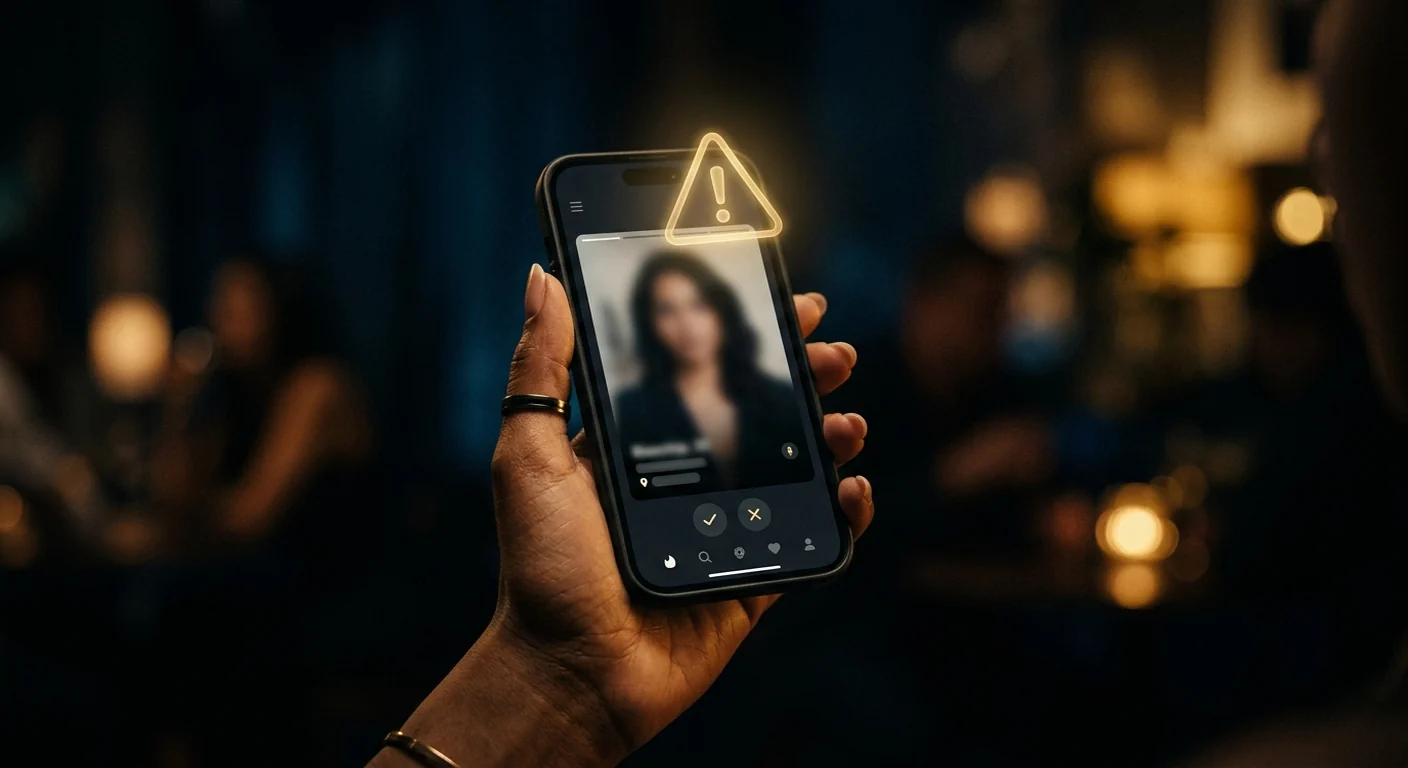
The photos are the weakest part of the disguise. A catfish can fake a job, a city and a dead parent. What it cannot easily fake is a photo set that has never appeared anywhere else on the internet.
The Short Version
- A catfish profile is built for a glance, not for scrutiny — the photo set is where it breaks.
- Reverse image search on two or three photos catches most fakes in under two minutes.
- The strongest single signal is a permanent reason video calls never work.
- The move off Tinder to WhatsApp or Telegram is the point where the account becomes disposable.
- Money is never asked for directly at first; it arrives as a crisis after weeks of trust-building.
What Catfishing on Tinder Actually Is
A catfish is a profile that presents a person who does not exist, or a real person who is not the one typing. On Tinder the second version is more common than people expect: the photographs belong to a real individual — a model, a soldier, an influencer — whose identity was lifted from Instagram and reused across dozens of accounts.
The purpose is not always money. Some catfish want intimate images, which become sextortion material. Some want a visa, a phone number, or an address. Some are running a long game that only becomes financial after two months of daily conversation. The common thread is that the relationship must stay on a surface the catfish controls.
That is why the profile itself is only half the evidence. The other half is what happens in the first week of conversation, and specifically what the person does when you suggest something verifiable.
The Six Signals That Actually Predict a Fake
Most published lists of "catfish signs" are useless because they describe behaviour that honest people also show. These six are different: each one is a structural feature of how catfishing works, not a personality trait.
- One photo, many faces. The photo set is inconsistent — different jawlines, different skin tones, different camera quality, and no ordinary candid shots. A real person's camera roll has bad photos in it.
- No verifiable history. The Instagram or Facebook linked from the profile is new, has few posts, or does not exist at all. A real person of the age claimed usually has a decade of digital debris.
- A permanent reason video never works. Camera broken, military deployment, religious restriction, a sick parent in the room. One excuse is plausible. A permanent, well-maintained excuse is the script.
- Instant intensity. Declarations of love, talk of marriage or a shared future, and constant messaging within days. This is a technique for compressing the trust-building timeline.
- The push off the app. A quick move to WhatsApp, Telegram or Signal, framed as "I am not on here much". This is where the account becomes disposable and the platform's reporting tools stop working.
- Geography that never quite resolves. The city changes, or the person is "travelling" indefinitely, or is always about to visit but never does. Distance is what makes a meeting impossible without an obvious lie.
The Two-Minute Reverse Image Test
This is the highest-yield check available and it costs nothing. Save two or three photos from the profile — ideally one face shot and one full-body or lifestyle shot — and run each through a reverse image search.
Google Lens, Bing Visual Search and Yandex all work, and they return different results, so run at least two. What you are looking for is not "this photo appears elsewhere" — a real person's photo can be reposted. You are looking for the photo attached to a different name, a different country, or a stock-photo listing.
Yandex is particularly strong on faces and on images scraped from Eastern European and Russian social networks, which is where a large share of stolen identity packs originate. If a photo returns a VK or Odnoklassniki profile under another name, the case is closed.
Why the Move Off Tinder Matters
Tinder's reporting and blocking tools only work inside Tinder. The moment a conversation moves to WhatsApp or Telegram, the platform loses visibility, the account can be deleted and recreated in minutes, and the evidence lives on a service that will not act on a report from a stranger.
This is not an argument that everyone who suggests WhatsApp is a scammer — most people prefer it. It is an argument that the move should be your decision, made after you have verified something, not a condition of continuing the conversation.
A useful counter-move: agree to move, but ask for one verifiable thing first. A live video call of thirty seconds, or a voice note saying a phrase you choose. A genuine person finds this mildly odd and does it. A catfish finds a reason, and the reason is the answer.
The Money Ladder: How the Ask Actually Arrives
Money is almost never requested in the first conversation. It arrives as the resolution to a crisis, and the crisis is calibrated to the relationship's age.
Week one to three: no money at all. The goal is emotional investment. Week three to six: a small test — a phone bill, a taxi, a prescription — small enough that refusing feels petty. If that is paid, the amounts escalate and the stories become more urgent: a hospital, a customs fee, a blocked account, an investment that needs one more deposit to release a larger sum.
Each request is designed so that the previous payments become a reason to pay again. "You have already sent this much, do not lose it now" is the most effective sentence in the entire script, and it works because it is true — the earlier money is gone either way.
The moment a request arrives, the relationship has revealed its purpose. There is no version of this where paying once resolves it.
Reporting and Preserving Evidence
Before you block, capture: the profile URL and username, the exact name and age shown, every photo, the full message history, and any payment receipts or wallet addresses. Screenshots with timestamps are worth more than a description written from memory a week later.
Report inside Tinder first — it removes the account and feeds the platform's detection. Then report to your national fraud body if money has moved: the FTC's ReportFraud portal in the US, Action Fraud in the UK, the local cybercrime unit elsewhere. If intimate images were shared and threatened, that is sextortion and it should be reported to the same bodies plus the platform's dedicated intimate-image service.
Finally, expect the second contact. A catfish crew that has your number will try again with a different profile, sometimes months later, sometimes referencing details from the first conversation to seem credible. Knowing that in advance is the best protection against it.
Questions people ask
How can I tell if a Tinder profile is fake?
The fastest reliable test is a reverse image search on two or three photos using Google Lens and Yandex. If the same face appears under a different name or in a different country, the profile is fake. A permanent reason video calls never work is the second strongest signal.
Is Tinder verification enough to prove someone is real?
No. Photo verification confirms that a live person matches the photos at that moment. It does not confirm identity, and it does not stop a verified account from being sold or handed to someone else afterwards. Treat it as one weak signal, not proof.
What should I do if a Tinder match asks for money?
Stop and do not send anything. A request for money from someone you have never met in person is the purpose of the relationship, not a complication in it. Preserve the messages, report the profile, and block.
Can I get money back if I sent it to a Tinder catfish?
Sometimes, and only quickly. Report the transaction to your bank or payment app the same day as fraud, because the window for intercepting funds is measured in hours. Recovery after that depends on the receiving institution and is not guaranteed.
Do catfish ever meet in person?
Rarely, and when they do it is usually a different person from the one in the photos — a mule, a recruiter, or an accomplice. A meeting that keeps being postponed for months is itself the evidence.
Check the address before you send anything
A free scan reads public chain data in your browser: balance, activity, counterparties and flags. No wallet connection, no seed phrase, no signup.
Primary sources and further reading
- FTC romance scam topic page — reported losses and the standard escalation pattern
- FBI Internet Crime Report — confidence fraud and romance complaint data
- Tinder safety guidance — in-app reporting, photo verification and blocking
- Action Fraud (UK) — reporting route for UK victims
Related guides
Information only. We never promise recovery.