Crypto Scam Evidence Checklist: Everything to Preserve, In Order
Evidence is what turns a loss into a case, and it disappears when a platform goes offline. Here is everything to preserve, the order to preserve it in, and how to store it so it survives the next six months.
Crypto Scam Evidence Checklist: The Five Steps
- Evidence is what turns a loss into a case, and it disappears when a platform goes offline.
- Preserve in this order: platform screenshots, payment records, identifiers, then the narrative.
- Identifiers are the part victims leave thin, and they are the part that makes a report matchable.
- Copy identifiers rather than retyping them. One wrong character turns a report into a false lead.
- Store the set in two places, one of them offline, and keep it for at least six years.
A loss becomes a case when it is documented. The difference between a complaint that is filed and a complaint that is acted on is usually specificity: exact addresses, exact hashes, exact amounts, exact dates. Those details are available for a short window, and then the platform goes offline and they are gone.
This tutorial is a checklist. It covers what to preserve, the order to preserve it in, and how to store it so it is still usable in six months when a bank, an exchange or a lawyer asks for it.
Why the window is short
Fraudulent platforms are taken offline quickly, and when they go, the dashboard, the balance, the chat history and the deposit page go with them. The blockchain record survives, but everything that explains the context does not.
That is why the order matters. The things that disappear are preserved first, and the things that persist are preserved second.
| Evidence | Survives the platform going offline? | Priority |
|---|---|---|
| Platform dashboard and balance | No | First |
| Support chat and messages | No | First |
| Deposit and withdrawal pages | No | First |
| Payment records from your bank | Yes, if you download them | Second |
| Wallet addresses and transaction hashes | Yes, on the public ledger | Second |
| Your written narrative | Yes, if you write it | Third |
Screenshot the platform before you do anything else. The dashboard, the balance and the chat are the only evidence that the platform ever existed in the form you saw, and they vanish when it is taken down.
Step one: the platform screenshots
Capture the platform in full, not selectively. A screenshot of the balance alone is less useful than a set that shows the dashboard, the deposit page, the withdrawal page and the support conversation, because the set establishes what you were shown and what you were told.
Include the URL bar in every screenshot. It establishes the domain, which is one of the identifiers that makes a report matchable.
- 01Screenshot the dashboard, including the balance and any profit figures.
- 02Screenshot the deposit page, including the address you were given.
- 03Screenshot the withdrawal page, including any fee or requirement shown.
- 04Screenshot the full support conversation, scrolling to capture all of it.
- 05Screenshot any group chat, including member counts and names.
- 06Include the URL bar in every capture.
Include the URL bar. The domain is an identifier, and a screenshot without it establishes what you saw but not where you saw it.
Step two: the payment records
Payment records come from your own accounts, and they are the part that institutions can act on. Download statements rather than screenshotting them, because a statement is a document and a screenshot is an image.
Record every payment in order, including the ones you would rather forget. A complete record is more credible than a selective one, and the later payments are often the ones that establish the pattern.
- 01Download bank and card statements covering the full period.
- 02Record every payment to the platform, in date order, with amounts.
- 03Record every crypto transfer, with the transaction hash and the receiving address.
- 04Record any fee paid at the withdrawal stage separately.
- 05Note the payment method for each entry.
- 06Keep the original files, not just the summary you write from them.
Download statements rather than screenshotting them. A statement is a document an institution can verify; a screenshot is an image they have to take on trust.
Step three: the identifiers
Identifiers are the part victims leave thin, and they are the part that makes a report matchable. An analyst searching for your case searches for strings: an address, a domain, a phone number, a handle. If those strings are not in your report, your case cannot be found.
Copy identifiers rather than retyping them. A single wrong character turns your report into a false lead and wastes the analyst's time.
| Identifier | Where to find it |
|---|---|
| Wallet addresses | Your wallet history and the platform's deposit page |
| Transaction hashes | Your wallet history and a public explorer |
| Platform domain | The URL bar in your screenshots |
| App name and store listing | The app store page, if there was one |
| Phone numbers | The messages you received |
| Email addresses | The messages and any onboarding emails |
| Handles and usernames | Social media and group chats |
| Referral codes | Any link you were sent |
Never retype a wallet address from a screenshot. Copy it from the source, and paste it into your document. One wrong character makes the whole report unusable for matching.
Step four: the written narrative
The narrative is what ties the evidence together, and it should be written as a dated timeline rather than a story. Investigators work from sequences, and a sequence is checkable in a way that a narrative is not.
Write it once, in plain language, and keep it to a page. The detail belongs in the evidence set; the narrative is the index to it.
- 01Write a one-page timeline: date, event, amount, and what you did.
- 02State the total loss as a single figure.
- 03List the identifiers separately at the end.
- 04Note what you have already done: reports filed, institutions contacted.
- 05Keep it factual and avoid speculation about who was responsible.
- 06Date the document and sign it.
Write for the query, not for the reader. Ask what an analyst would search for to find your case, and make sure those exact strings appear in your document.
Step five: storage
Evidence is only useful if it still exists when it is needed. Reports take months, civil claims take longer, and tax positions can be reviewed years later. Store the set in two places, one of them offline.
Keep the original files alongside your written summary. The summary is what you send; the originals are what you produce if the summary is questioned.
- Store the full set in two places, one of them offline.
- Keep original files, not only your written summary.
- Name files with dates so the sequence is obvious.
- Keep a copy of every confirmation number you receive.
- Do not store the set in the same account the fraudster contacted you through.
- Keep it for at least six years, which covers most limitation periods.
Two copies, one offline, originals kept. That is the whole storage policy, and it is what makes the evidence usable a year from now when someone finally asks for it.
The evidence set in one page
The complete set fits on a single page, and it is worth keeping that page with the files so the set can be assembled quickly when someone asks for it. Reports, disputes and legal consultations all begin with the same request.
The order below is the order to work in. The first three items disappear when the platform goes offline, so they come first.
| # | Item | Format |
|---|---|---|
| 1 | Platform screenshots with the URL bar | PNG or PDF |
| 2 | Support chat and group chat captures | PNG or PDF |
| 3 | Deposit and withdrawal page captures | PNG or PDF |
| 4 | Bank and card statements | Downloaded PDF |
| 5 | Crypto transfer records with hashes | Spreadsheet |
| 6 | Identifier list | Text document |
| 7 | One-page dated narrative | Text document |
| 8 | Confirmation numbers from every filing | Text document |
Keep this page with the files. When a bank, an exchange or a lawyer asks for the evidence, the request is always for the same set, and having it indexed saves a day.
The mistakes that weaken a report
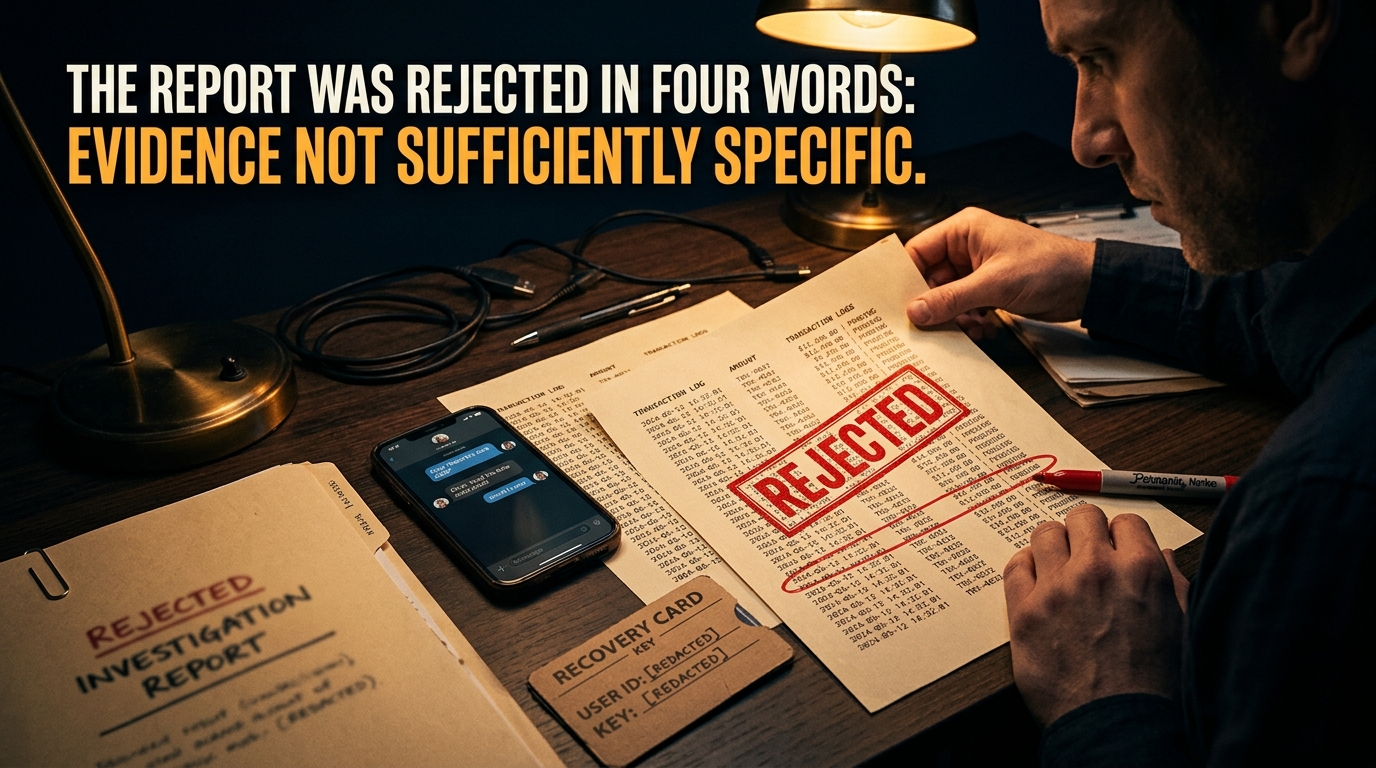
Most reports are not rejected because the loss was not real. They are rejected because the evidence was not specific enough to act on. The mistakes below are the ones that cause that, and each is avoidable.
The common thread is that each mistake replaces a verifiable fact with something that has to be taken on trust. Investigators work from verifiable facts.
| Mistake | Why it weakens the report | The fix |
|---|---|---|
| Retyping addresses | One wrong character creates a false lead | Copy and paste from the source |
| Screenshots without the URL bar | The domain cannot be established | Recapture with the URL visible |
| A narrative instead of a timeline | Sequences cannot be checked | Write a dated list |
| Selective payment records | The pattern is hidden | Include every payment, in order |
| No total figure | The loss cannot be quantified | State one total |
| No confirmation numbers | The report cannot be referenced | Record every reference you receive |
The most common rejection reason is that the evidence was not specific enough. Specificity is not about volume; it is about exact strings, exact dates and exact amounts.
The evidence in one page
The whole evidence set fits on a single page, and it is worth keeping it there so the order does not depend on remembering it. The things that disappear come first.
Work through it in order. The platform screenshots come first, because the site goes offline quickly and the record vanishes with it.
| # | Evidence | Why it comes here |
|---|---|---|
| 1 | Platform screenshots | The site disappears first |
| 2 | Bank and card statements | The payment record is the strongest evidence |
| 3 | Deposit addresses and hashes | The identifiers every later route needs |
| 4 | The conversation | Establishes the representations made |
| 5 | The identifiers | Domains, phone numbers, handles |
| 6 | The dated timeline | Turns the set into a narrative |
Print the list and work through it in order. The platform screenshots come first, because the site goes offline quickly and the record vanishes with it.
The evidence package
A set of files is not a package. A package is organised, indexed and accompanied by a one-page summary, and it is what turns a complaint into a lead that someone can act on.
The package is worth building once and reusing for every filing. The same set goes to the bank, the exchange, the police and the regulators, with the summary adjusted for each audience.
- Organise the files into folders by type: platform, payments, conversation, identifiers.
- Name every file with a date and a short description.
- Write a one-page summary with the total loss and the key identifiers at the top.
- Include the dated timeline as a single document.
- Keep the original files unedited, and work from copies.
- Reuse the same package for every filing, adjusting only the summary.
A package is organised, indexed and accompanied by a one-page summary. The same set goes to the bank, the exchange, the police and the regulators, with the summary adjusted for each audience.
Evidence Checklist: Questions About What to Keep
Build the Trace to Attach to Your Evidence Filing
Paste the receiving address into the tracer and export a dated hop record. A report with a written trace attached is a lead rather than a statistic.
Primary sources and further reading
- FBI IC3 — File a Complaint www.ic3.gov
- FTC — Report Fraud reportfraud.ftc.gov
- CFPB — Submit a complaint www.consumerfinance.gov
- Chainalysis — Crypto Crime Report www.chainalysis.com
External links open in a new tab and are provided so you can verify the underlying material yourself. TrueMoneyTalk is not affiliated with these organisations.
More prevention tutorials on evidence and filing
Someone you know may be in this situation right now.
Disclaimer: this guide is general information, not legal, financial or recovery advice, and it is not a substitute for advice from a licensed professional in your jurisdiction. Individual outcomes vary and are never guaranteed.