ETH Sent to the Wrong Network? The EVM Recovery Path
A wrong-network ETH transfer feels like a loss and usually is not one. The rule that decides your outcome is narrower than most guides admit: if both the sending and receiving chains derive addresses from the same private key in the same way, the ether is sitting at an address you can already sign for, on a chain your wallet was simply not showing. If they do not, it is not. This page is about telling those apart before you spend money or hand anyone your seed phrase.

ETH on the Wrong Chain. One Key, Many Chains
ETH Wrong Network: The Short Version
- Your address is the same across Ethereum, Arbitrum, Base, Optimism, Polygon, Avalanche C-Chain and the other EVM chains — because the key derivation is identical.
- Solana, Bitcoin, Tron and other non-EVM chains derive addresses differently. Your EVM address does not exist there, and funds sent across that boundary are usually gone.
- The fix is not a service. It is: add the receiving chain to your wallet, and the balance appears.
- For a token (not ETH) you must also add the token contract for that chain, or the balance stays invisible.
- Nobody can reverse a confirmed transfer. A "recovery fee" paid before you see the balance is the fraud.
The one rule that decides everything
Everything on this page follows from a single technical fact about how wallets work, and it is worth thirty seconds because it changes what you do next.
A crypto address is not an account someone created for you. It is calculated from your private key. On Ethereum and every chain built with the same address-derivation scheme — Arbitrum, Base, Optimism, Polygon, BNB Chain, Avalanche's C-Chain, Gnosis, and the rest of the EVM family — the same private key calculates the same address. Not a similar one. The identical 42-character string.
That means an ETH transfer you sent on Arbitrum, to an address you thought was on Ethereum, landed at an address that your own seed phrase already controls on Arbitrum. Nothing is lost. Your wallet is displaying the wrong chain.
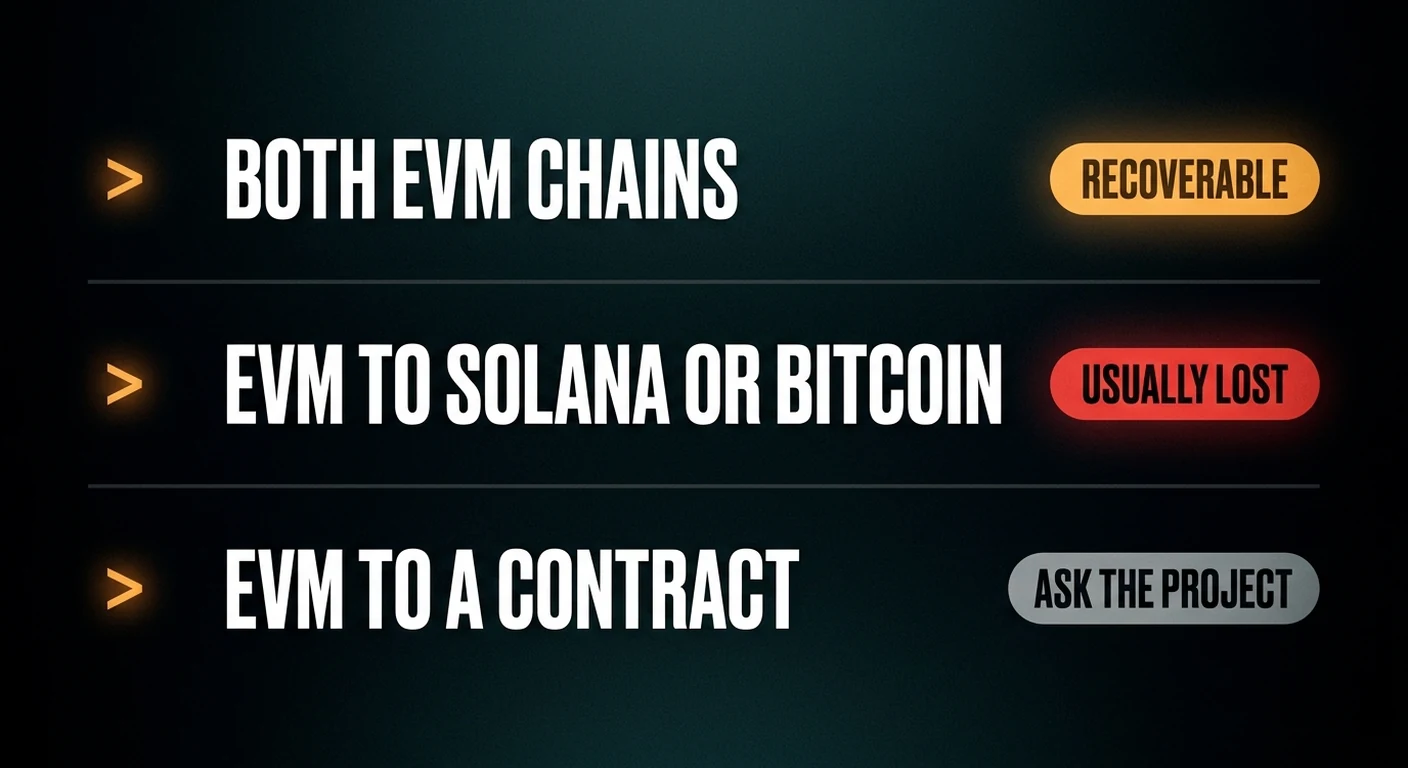
| If the two chains are… | Your address is… | Outcome |
|---|---|---|
| Both EVM (e.g. Ethereum → Base) | Identical | Recoverable by you |
| EVM → Solana, Bitcoin, Tron, Cosmos | Different derivation | Usually lost — not at "your" address there |
| EVM → a smart contract on any chain | Contract, not a key | Depends on the contract — ask the project |
Confirm the chain from the hash, not from memory
Wallets remember your last network selection, and the selector is small. Do not rely on what you believe you picked.
The not-found test
Copy the transaction hash and open the explorer for the chain you intended. If it says the transaction does not exist, you have your answer — it is on a different chain, and you can find it by trying the others. A "not found" is diagnostic information, not a failure.
| Chain | Explorer | Notes |
|---|---|---|
| Ethereum | etherscan.io | The default most people assume |
| Arbitrum One | arbiscan.io | Common source of L2 confusion |
| Base | basescan.org | Frequent because it is a wallet default |
| OP Mainnet | optimistic.etherscan.io | Easy to mix with Base |
| Polygon PoS | polygonscan.com | — |
| BNB Smart Chain | bscscan.com | Different gas token (BNB) |
| Avalanche C-Chain | snowtrace.io | — |
Once you find it, check two fields: To (where the funds are) and value (how much). If To matches one of your own addresses, you are in the good case and the rest of this is mechanical.
Confirming which of the two happened decides whether anything is recoverable, and telling a wrong address from a wrong network gives the test.
The recovery, in order
Four steps, and the order matters because doing step four first can strand the funds a second time.
| # | Action | Why in this order |
|---|---|---|
| 1 | Identify the chain the transfer actually used | Everything downstream depends on it |
| 2 | Add that network to the wallet holding the same key | The balance is invisible until the chain exists in the wallet |
| 3 | For a token, add the token's contract on that chain | Tokens are per-chain; the chain alone will not show them |
| 4 | Bridge or send to the intended chain | Only now. This is a new transaction with new gas and new risk |
If you need gas to move it
This is the practical snag: to move ETH off the receiving chain you need that chain's gas token. On most L2s the native token is ETH, so the recovered ETH pays for its own transfer. On BNB Chain you need BNB, and on Polygon you need POL. If you have none, buy a small amount on an exchange and withdraw it to that chain — do not accept an offer from a stranger to "send you gas" in exchange for access to the wallet.
If it was a token, not ETH
The chain step is the same, but the token will not appear until you add its contract address for that chain. Get that address from the project's official documentation. A token added from a search result can be a spoof designed to capture an approval — check the holder count on the explorer before you interact.
When it is genuinely not coming back
- Sent to a burn address — typically the all-zero address. No key exists for it; the funds are destroyed by design.
- Sent to a contract that cannot send out. Many contracts accept ETH and have no withdrawal function. If the contract is upgradeable, the project team may be able to help — ask them, and expect a no.
- Sent across the EVM boundary to a chain with different derivation. The address is not yours there, and it usually belongs to nobody reachable.
- Sent to a stranger who keeps it. The network did exactly what it was told.
A trace of the stolen crypto still has value in all four: it produces a record of where the funds went, which is what a police report and an exchange investigation actually need. It does not produce a refund, and any service that implies otherwise is selling you the second scam rather than the recovery. If the mistake was the address rather than the chain, the diagnosis page separates the two.
How the second scam arrives
This is a search that scammers monitor, because the person typing it has just lost money and is looking for an authority figure. Expect contact. The shapes are consistent.
| Approach | The claim | Why it cannot be true |
|---|---|---|
| "Blockchain recovery expert" | They can reverse the hash for a fee | No one can reverse a confirmed transfer, including the chain's own developers |
| "Gas fee to release your funds" | Pay a small amount and the ETH is released | Nothing is holding it. The fee is the entire business model. |
| Remote access offer | "Let me look at your wallet." | Screen sharing plus a seed phrase is a transfer of everything you own |
| Forum or DM "I had the same thing" | Recommendation of a named agent | Two accounts, one operator |
The reliable test is direction of payment: no legitimate process asks you to send crypto in order to receive crypto. A real retrieval by an exchange debits its fee from the recovered amount, after the fact.
Questions people ask about ETH on the wrong network
Is ETH sent to the wrong network recoverable?
Usually yes when both chains are EVM-compatible, because the same private key derives the same address on each. Your funds are at an address you already control on the receiving chain; you need to add that chain to your wallet to see them. When the destination is a non-EVM chain, a smart contract, a burn address or a stranger's address, there is usually no technical route back.
Why is my address the same on Ethereum and Arbitrum?
Because the address is calculated from your private key using the same derivation scheme on both chains. EVM-compatible chains share that scheme, so the same seed produces the identical address on Ethereum, Arbitrum, Base, Optimism, Polygon, BNB Chain and the rest. This is exactly why a wrong-network transfer within the EVM family is generally recoverable by the sender.
Can I recover ETH sent to a Solana or Bitcoin address?
Generally no. Solana and Bitcoin derive addresses differently from EVM chains, so your Ethereum address does not exist on those networks and importing your seed phrase there does not recreate it. If the destination was a valid address on that network, it belongs to whoever holds its key, and only their voluntary return can help.
Do I need gas to move recovered ETH?
Yes. Moving funds off the receiving chain requires that chain's gas token. On most Ethereum L2s the native token is ETH, so the recovered ETH pays for its own transfer. On BNB Chain you need BNB and on Polygon you need POL. Buy a small amount through an exchange and withdraw it to that chain rather than accepting gas from a stranger.
Will MetaMask recover funds I sent to the wrong network?
MetaMask's own guidance is that a confirmed transaction is final and that no one, including MetaMask, can revert it. For EVM-compatible wrong-network sends the recovery tool is your own wallet: add the receiving network and the balance appears. MetaMask will never contact you directly about this, and any message claiming to be from MetaMask support is a scam.
Check the destination before you act on it
The hash tells you whether the funds sit at an address you control or at someone else's. That single fact decides whether there is anything to recover.
Primary sources and further reading
- MetaMask — I sent crypto to the wrong place — support.metamask.io
- Blockscout — Sent tokens to the wrong network? — blog.blockscout.com
- FBI IC3 — File a Complaint — ic3.gov
- TrueMoneyTalk — USDC Sent to the Wrong Network — truemoneytalk.com
Related guides
Information only. We never promise recovery.