Wrong Address or Wrong Network? How to Tell, and What Each Means
There is no single answer to "can you recover crypto sent to the wrong address", and the reason is that people use that sentence for five different mistakes with five different outcomes. Two are recoverable in under an hour by the sender alone. One needs an exchange. Two are final. This page is the diagnosis, not the procedure — five questions, then a decision, then the page that handles your case.

Wrong Address or Wrong Network. The Answer Depends on Which
The Short Version: Five Mistakes, Three Outcomes
- Same address, different chain → usually recoverable by you, because your key derives that address on both chains.
- Exchange deposit address, unsupported chain → only the exchange can credit it. One ticket, nothing more sent to that address.
- Valid address belonging to a stranger → no technical route. Only their goodwill.
- Burn address or a contract with no withdrawal → final. Nothing recovers it.
- Non-EVM mismatch (EVM address used on Solana, Bitcoin, Tron) → usually final, because the address is not yours there.
Why the diagnosis has to come first
The wrong action taken early is what turns a recoverable mistake into a permanent one. Two examples are common enough to name.
Someone who sent to their own address on the wrong chain and believes the funds are lost will often start contacting "recovery" services. That is the moment the second scam begins, and it begins on a case where ten minutes in their own wallet would have finished it.
Someone who sent to a stranger's address and believes it is recoverable will spend weeks and often money pursuing a technical fix that does not exist, while the one genuinely useful action — filing a report that preserves a record — gets delayed.
The five questions, in order
Work down the list and stop at the first one that matches. The order is deliberate: the cheap, checkable explanations come first.
| # | Question | If yes |
|---|---|---|
| 1 | Does the hash resolve on the chain you intended to use? | There may be no wrong-network problem at all — check confirmation status and the recipient's token list first |
| 2 | Is the To address one of your own? | Recoverable by you. Add the receiving chain to your wallet |
| 3 | Is the To address an exchange deposit address? | Exchange route. One ticket, send nothing else |
| 4 | Is the To address a known burn address or a contract? | Usually final. A contract may be recoverable if the project can act |
| 5 | Is the To address a stranger's, on a chain whose format matches? | No technical route. Goodwill or a report only |
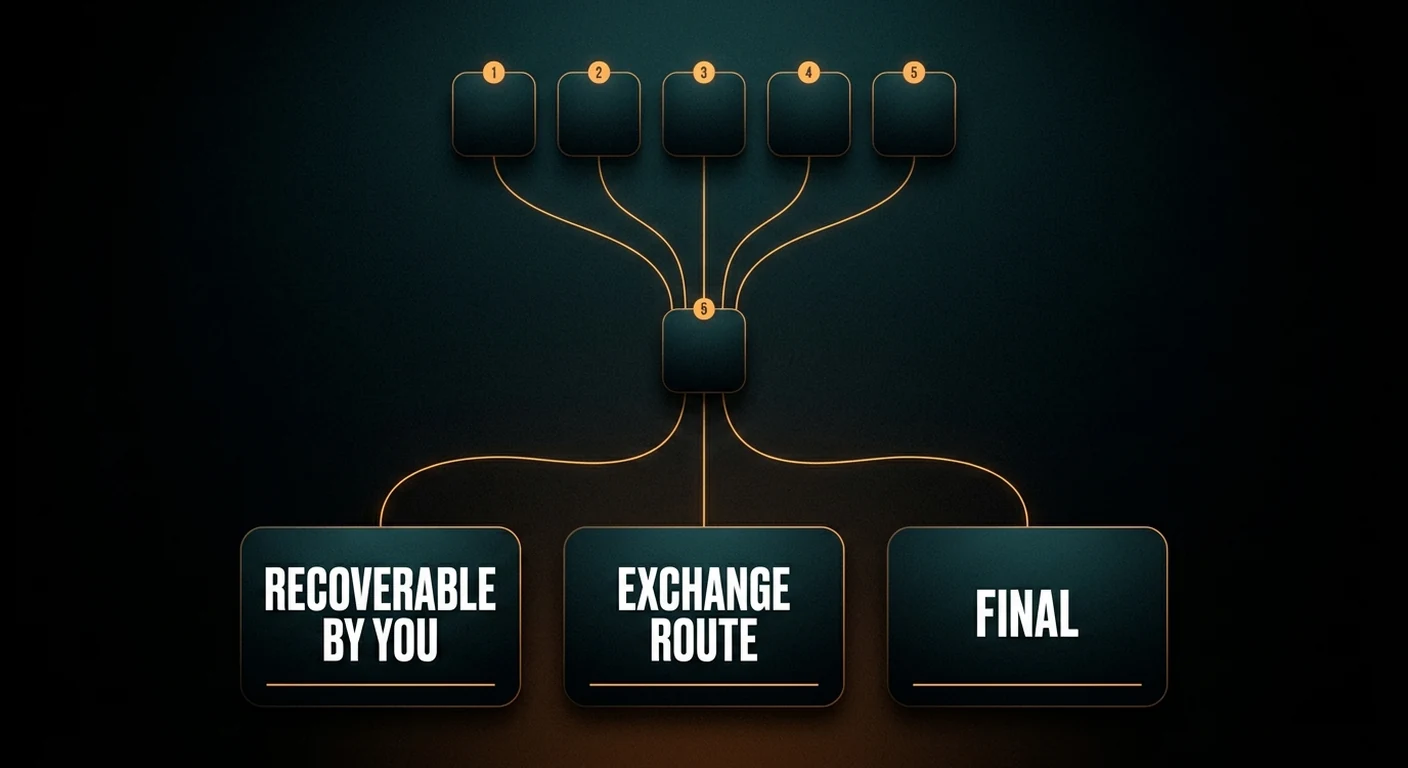
If question 2 is yes, stop reading and go to the recovery procedure for your chain type. If question 3 is yes, stop and write the ticket. Questions 4 and 5 are where honesty is more useful than hope.
The phrase "wrong address" is doing too much work
The confusion is linguistic before it is technical. "I sent it to the wrong address" describes a mistake about destination. "I sent it on the wrong network" describes a mistake about route. They feel identical to the person who made them and behave completely differently.
| Wrong network | Wrong address | |
|---|---|---|
| What is wrong | The chain selected in the wallet | The destination string |
| Who holds the key | Often you, if the destination was your own address | Someone else, or nobody |
| Typical outcome on EVM | Recoverable in minutes | Recoverable only by goodwill |
| Typical outcome across EVM→non-EVM | Usually final | Usually final |
| Who can act | You, or the exchange | The recipient, or a court reaching a custodian |
The practical consequence: a wrong-network send to your own address is the only one of these you can finish yourself, and it is also the most common. That asymmetry is why so much online advice about "lost crypto" is either wildly optimistic or needlessly despairing — the writers are describing different mistakes with the same words.
When an exchange is involved, the outcome is administrative
An exchange deposit address is an address whose key the exchange holds. If your funds are there, the technical question is settled — they are not lost, and they are also not yours to move. Whether you get them back is a matter of that exchange's process.
What determines the answer in practice:
- Whether the exchange supports the chain at all. Recovery is routine for chains they run; impossible on a chain they have no infrastructure for.
- Whether the address was credited to any account. Sometimes the deposit lands in a suspense balance that support can see and move.
- How clearly your ticket identifies the transfer. A ticket with a hash and the chain name moves; a ticket describing the situation in prose does not.
Exchanges that perform this service typically charge a retrieval fee, and it is legitimate when charged by the exchange through its own published process. A fee demanded by a third party is a different thing entirely.
The two final cases, stated plainly
This section exists because false hope has a cost, and because the people selling recovery services depend on it.
A burn address is destroyed by design
Burn addresses — the all-zero address is the common one — have no known private key. A transfer to one is not stuck, not pending, and not awaiting a fee. It is gone in the same sense that a deleted file with no backup is gone. No service, no developer, and no fee changes that.
A stranger's address belongs to a stranger
If the address is valid, on the right chain, and belongs to someone else, the network did exactly what it was instructed to do. That person has no obligation to return anything, and you have no technical means to compel it. Two things remain, and only two: asking them (which requires them to be identifiable and willing), and creating an official record that might matter if the funds later pass through a custodial service.
In both cases, a trace is still worth doing — it documents where the funds went, which is what an IC3 complaint or an exchange fraud investigation actually needs. What it does not do is return the funds. Keep those two outcomes separate when you decide what to spend.
Where to go once you know which case you are in
| Your case | Next page | Time |
|---|---|---|
| Your own address, wrong EVM chain | ETH Sent to the Wrong Network | 10 minutes |
| USDC specifically, wrong chain | USDC Sent to the Wrong Network | 10–15 minutes |
| Any token, any chain, wrong address | Sent Crypto to the Wrong Address | 12 minutes |
| Exchange deposit address | Sent Crypto to the Wrong Address — exchange section | Ticket plus wait |
| Funds moved on by a third party | How to Trace Stolen Crypto | 20 minutes |
| Scammed rather than mistaken | Was I Scammed? | 8 minutes |
If your case is final, the useful work is documentation rather than recovery: a written trace, an IC3 complaint, and a bank or exchange fraud report where a custodial party is involved. None of those promise an outcome. All of them are things a recovery fee cannot buy you.
Diagnosis questions people actually type
Can you recover crypto sent to the wrong address?
It depends on who controls the destination. If the address is your own on a different EVM chain, yes — the same key derives that address, so the funds are already yours and only need the chain added to your wallet. If it is an exchange address, the exchange may credit or return it through a support process. If it is a burn address, a contract with no withdrawal function, or a stranger's address, there is no technical route back.
What is the difference between a wrong address and a wrong network?
A wrong network means the destination string is correct but the chain selected in your wallet was not; on EVM chains this is usually recoverable because your key controls the same address on both. A wrong address means the destination belongs to someone else, and only their voluntary return can help. Confirm which one happened from the transaction hash rather than from memory, because the two have opposite outcomes.
How do I know which mistake I made?
Open the transaction hash in the block explorer for the chain you intended to use. If it does not resolve there, you used a different chain. Then read the To field and compare it against your own addresses. That single comparison tells you whether the funds are at an address you control, at an exchange's address, or at someone else's.
Can a bank or exchange reverse a crypto transfer?
No one can reverse a confirmed on-chain transfer, including exchanges and the chain's developers. An exchange can only act on funds at an address whose key it controls, and its action is a credit or a return rather than a reversal. Claims that a hash can be unwound through a company, a regulator or a fee are the standard opening of a recovery scam.
Is it worth paying a service to recover crypto sent to the wrong address?
No. No service can reverse a confirmed transaction, so any upfront fee is buying a promise rather than a service. Services that charge only from successfully recovered funds are structurally unable to deliver on the cases they promise to fix. If your case is recoverable, the recovery is something you or the exchange does; if it is not, no payment changes it.
Start from the hash, not from the story
The To field tells you whether the funds are yours to reach, an exchange's to release, or nobody's to return. Everything else follows from that.
Primary sources and further reading
- MetaMask — I sent crypto to the wrong place — support.metamask.io
- Circle — Sent USDC to the wrong address or network — help.circle.com
- FBI IC3 — File a Complaint — ic3.gov
- TrueMoneyTalk — Sent Crypto to the Wrong Address? — truemoneytalk.com
Related guides
Information only. We never promise recovery.