How to Check a Bitcoin Address: Balance, History and Validity
Most people check a Bitcoin address after they have already sent to it. That is the wrong order. The five checks below take about ten minutes, need no account and no software, and answer the only question that matters before a transfer: is this address what the person who gave it to me says it is? Run them in sequence, because each one can end the process early. Once you have the string, the checks that matter are the same everywhere, and locating a Bitcoin address in Cash App covers balance, history and validity.
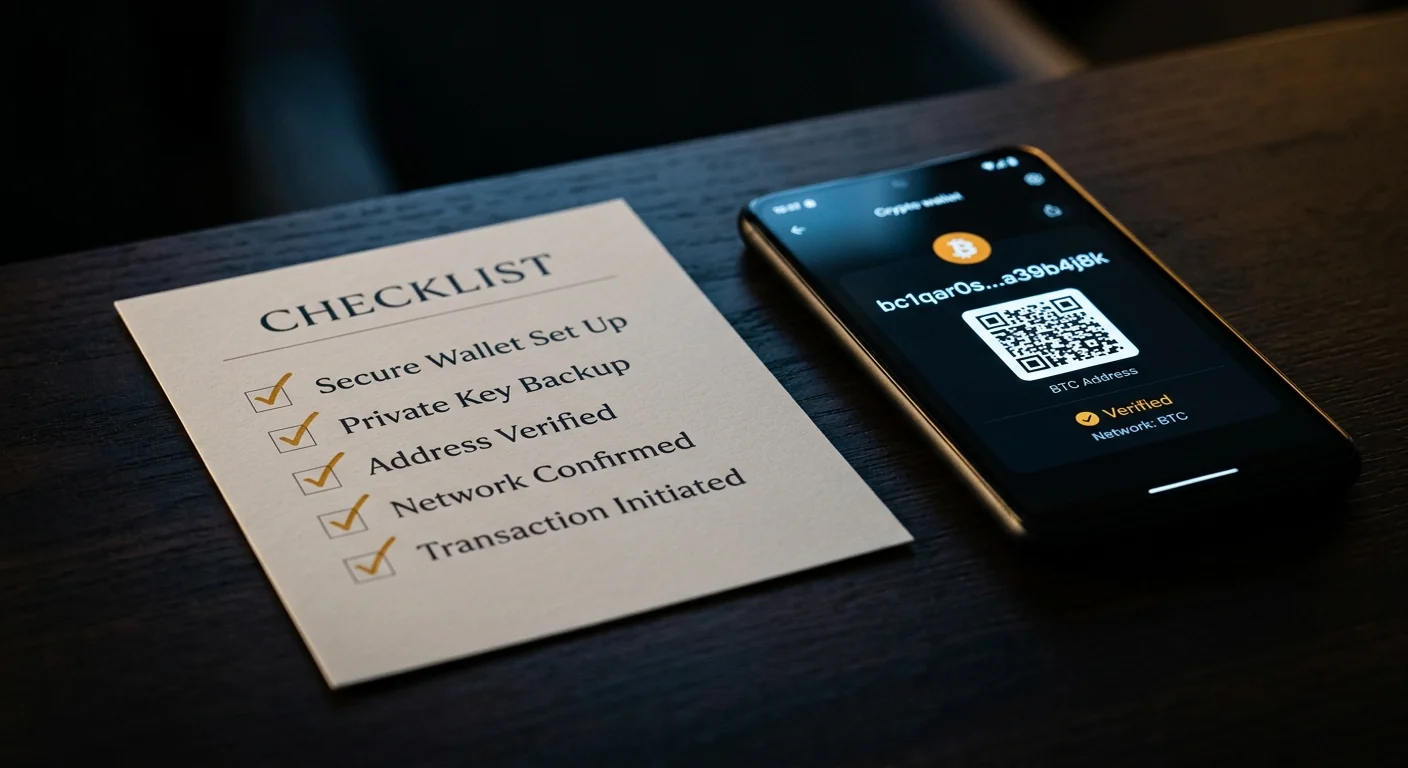
Ten minutes before you send beats ten months after. Every check below is free, public and repeatable — and each one can stop a loss before it happens.
The Short Version
- Check 1 is validity and network: a Bitcoin address must start with 1, 3 or bc1, and a checksum must pass.
- Check 2 is balance — but a zero balance is normal for a collection address and is not a red flag on its own.
- Check 3 is history: many small incoming payments to one address is the signature of a scam collection wallet.
- Check 4 is fiat value at the time of receipt, which is the figure a report or a tax claim actually needs.
- Check 5 is flag status. Absence from a scam list proves nothing; presence on one is a hard stop.
The Five Checks That Matter
There are dozens of things you could look at on a Bitcoin address. Five of them change your decision. The rest are detail you can add later if something looks wrong.
| # | Check | Question it answers | Time |
|---|---|---|---|
| 1 | Validity and network | Is this a real Bitcoin address, and is it on the right chain? | 10 seconds |
| 2 | Current balance | Is there anything there now? | 30 seconds |
| 3 | Transaction history | How is this address used, and by how many people? | 3 minutes |
| 4 | Fiat value at receipt | What was this worth when the money moved? | 2 minutes |
| 5 | Flag status | Has anyone already reported it? | 2 minutes |
Run them in this order deliberately. Check 1 is a hard gate — if the address is malformed or on the wrong network, nothing else matters and you should stop. Check 5 is the other hard gate: if the address appears on a maintained scam list, you have your answer regardless of what the balance looks like.
The middle three are judgement calls. They rarely produce a clean yes or no, but they reliably separate an address that behaves like a personal wallet from one that behaves like a collection point for fraud.
Check 1: Is the Address Valid and on the Right Network
Bitcoin has three address formats in current use, and the first character tells you which one you are looking at.
- Starts with 1 — legacy P2PKH. The oldest format, still fully supported, slightly more expensive to spend from.
- Starts with 3 — P2SH, usually a SegWit-wrapped or multisig address.
- Starts with bc1 — native SegWit (bech32). Lower fees, and the format most modern wallets default to.
Anything else is not a Bitcoin address. An address starting with 0x is Ethereum or another EVM chain. One starting with T is TRON. One starting with r is XRP. Sending BTC to any of those is a permanent loss, because the receiving chain has no idea what to do with the funds and no one can reverse it.
Length matters too. Legacy addresses are 26 to 35 characters. Bech32 addresses are longer and use only lowercase letters and digits, with no characters that could be confused for each other. If an address contains a capital letter and starts with bc1, it is malformed — bech32 is defined as case-insensitive but must not be mixed case.
That last point is where most losses actually happen. The address is valid, the checksum passes, the network is right — and it still belongs to a scammer, because the scammer is the one who supplied it. Validity protects you from typos, not from fraud.
Check 2: Current Balance
Paste the address into any block explorer and read the balance. Then read it again with the right expectations.
For a personal wallet you are about to pay, a balance near zero is unremarkable — people keep most of their funds elsewhere. For a merchant or an escrow address, a healthy balance is normal. For an address a stranger gave you in a chat, a balance of exactly zero with a busy history is the pattern to watch for.
| Balance | History | Reading |
|---|---|---|
| Zero | No transactions at all | Brand new address. Common for a fresh scam wallet, also common for a careful individual. |
| Zero | Many transactions, all swept | Collection address. Funds arrive and leave within minutes. |
| Small, static | Few transactions | Looks like a personal wallet holding a modest amount. |
| Large | Thousands of transactions | Custodial or exchange wallet. Not an individual. |
Do not treat a large balance as reassurance. A scam operation that has collected from hundreds of victims will show a large balance right up until the moment it sweeps. Conversely, do not treat a zero balance as proof of fraud — plenty of legitimate addresses are empty because the money was spent.
What you are looking for is coherence. Does the balance and history match the story you were told? A "friend" who says they are sending you funds from their personal savings, from an address with four thousand incoming payments of identical size, is not describing a personal savings account.
Check 3: Transaction History
The transaction list is where an address reveals its purpose. Read it for shape rather than for individual amounts.
Many small incomings, few large outgoings. This is the classic collection pattern. Dozens or hundreds of payments arrive, each roughly the size of a typical victim loss, and periodically the whole balance leaves in one transfer. If you are about to become the next small incoming, stop.
One incoming, one outgoing, repeated. A pass-through or peel chain. Each address receives once and forwards once, often slightly less than it received. This is deliberate obfuscation and it is the pattern most tracing work is built to follow.
Round-number transfers. Payments of exactly 0.01, 0.05 or 0.1 BTC across many addresses suggest automated splitting rather than genuine commerce, where amounts are rarely round.
Bursts followed by silence. A cluster of activity over a few days and then nothing for months is typical of a campaign that has moved on to new addresses.
Also check the age of the first transaction. An address created last week that has already received forty payments is not a long-standing business. Age plus volume together give you a much better read than either alone.
Reading one address's history is the first step; following value across many addresses is a different exercise, covered in tracing stolen Bitcoin through the ledger.
Check 4: Value in Fiat at the Time of Receipt
This check exists for a reason that has nothing to do with deciding whether to send: it is the figure you will need later if something goes wrong.
A police report, an insurance claim, a tax filing and a civil complaint all ask for a loss amount in a currency the reader understands. "0.42 BTC" is not that. The relevant figure is what those 0.42 BTC were worth at the moment of the transfer, and that number is not the same as what they are worth today.
Every block explorer shows a historical price alongside each transaction, usually sourced from a price index. Record three things:
- The fiat value at the time of the transaction, as shown by the explorer, with the explorer named.
- The timestamp in UTC, because a price can move several percent within an hour and the exact minute matters.
- The rate source, so that anyone reviewing the figure can reproduce it.
If the loss is large enough to matter legally, take a second reading from an independent price source for the same timestamp. Two sources agreeing is a much stronger position than one explorer's internal number, and it costs you two minutes.
For a tax claim the treatment is different again — the relevant value may be at the time of the theft rather than the time of the transfer, and the rules changed in 2017. That is a question for a tax professional, not for an explorer.
Check 5: Has It Been Flagged
Several organisations maintain lists of addresses associated with fraud, sanctions, ransomware or sanctioned entities. Checking them is quick and occasionally decisive.
The most authoritative is the US Treasury's OFAC sanctions list, which includes specific crypto addresses. Interacting with a sanctioned address can create legal exposure independent of any scam, so this check is not optional if you are moving meaningful sums. Chainalysis, TRM Labs and several exchanges also publish or maintain scam-address datasets, and many explorers surface a warning banner when an address appears on one.
Presence on a list, on the other hand, is close to a hard stop. If an address you are about to pay appears on a sanctions list, do not send. If it appears on a scam-reporting dataset, treat the transaction as cancelled and report the person who gave you the address.
One practical note: some explorers show a "risk score" without saying what it is based on. A score with no stated methodology is marketing, not evidence. Prefer sources that name the list they checked.
Reading a Confirmed vs Unconfirmed Transaction
Once a transfer exists, its status matters as much as its content.
An unconfirmed transaction is in the mempool: broadcast to the network but not yet included in a block. It has a transaction ID and it is visible on explorers, but it can still be replaced. Bitcoin allows a sender to replace an unconfirmed transaction with a higher-fee version that pays a different address, which means an unconfirmed payment is not final.
A confirmed transaction has been included in a block. One confirmation is enough for most consumer purposes. Six confirmations is the traditional threshold for treating a large payment as irreversible, because reversing it would require reorging six blocks of accumulated proof-of-work.
| Status | What it means | What to do |
|---|---|---|
| 0 confirmations | In the mempool, replaceable | Do not treat as paid. Wait. |
| 1 confirmation | In a block, practically final for small sums | Safe to act on for consumer amounts |
| 3–6 confirmations | Deeply settled | Safe for large sums and for evidence |
| Dropped | Removed from mempool, never confirmed | The payment did not happen |
For evidence purposes, always capture the confirmation count at the moment you record the transaction, and note the block height. A transaction that showed one confirmation when you screenshotted it and twelve when the officer looks at it is not a discrepancy — it is just time passing, and stating the block height makes that obvious.
Screenshot the Result for Your Evidence Pack
A check you cannot reproduce is a check that will be questioned. Capture the result properly the first time.
What to save, for each address you check:
- A full-page screenshot showing the address, the balance, the transaction count and the explorer's URL bar. The URL matters because it proves which tool produced the figure.
- The address as text, copied rather than typed, in a plain text file. Screenshots of long strings are frequently misread by OCR and by humans.
- The transaction IDs of the transfers that matter, one per line.
- A timestamp of when you captured it, in UTC.
- The fiat value at receipt, with the rate source named.
Store these in one folder with a consistent naming scheme — the address, then the date, then the check number. If you end up with twenty addresses, that structure is the difference between a coherent evidence pack and a pile of images nobody can follow.
Our free wallet tracer runs checks 1 through 3 in one pass and produces a summary you can save, which removes most of the manual copying. The report builder then assembles the pack into a document formatted for a police report or an IC3 complaint. Neither tool can tell you whether to trust the person who gave you the address — that judgement stays with you, and it is the one that matters most.
Questions people ask
How do I know if a Bitcoin address is real?
Check the format and the checksum. A valid Bitcoin address starts with 1, 3 or bc1, is 26 to 62 characters long, and passes a checksum that any wallet or explorer will verify. A wallet refusing to accept an address you typed usually means the checksum failed.
Can I check a Bitcoin address without an account?
Yes. Every block explorer offers address lookup with no registration, no login and no payment. The data is public by design. Any service requiring an account to show you a balance is adding friction to something that is free.
What is a red flag on a Bitcoin address?
Many small incoming payments from distinct senders, rapid sweeping of the full balance to a new address, round-number transfers, and a very young address with high volume. Any one of these is worth a second look; two together is a strong signal.
Does a zero balance mean the address is unused?
No. A zero balance with a long transaction history means funds arrived and were moved on, which is exactly what a fraudster collection address looks like. Check the transaction count, not just the balance.
Should I check an address before or after sending?
Before, always. Every check in this guide is free and takes minutes, and each one can stop a loss. After a transfer the same checks still work, but they become documentation of a loss rather than prevention of one.
Check the address before you send anything
A free scan reads public chain data in your browser: balance, activity, counterparties and flags. No wallet connection, no seed phrase, no signup.
Primary sources and further reading
- OFAC Sanctions List Service — the US Treasury list that includes designated crypto addresses
- FBI Internet Crime Complaint Center — federal reporting portal for crypto fraud
- Bitcoin Developer Reference — address formats, checksums and transaction structure
- Chainalysis research — public work on address clustering and risk labelling
Related guides
Information only. We never promise recovery.